Intersection of the two longest Texas state highways
^ date reposted to this blog
Feb. 01, 2017: originally posted to my old blog
At 568 miles*, Texas 16 is the longest state highway in Texas (that is, the longest road with a state highway designation, as opposed to a US route or an interstate). The second-longest is Texas 6, at 551 miles*. These two routes intersect in the town of De Leon. Actually, they overlap for about a half-mile:
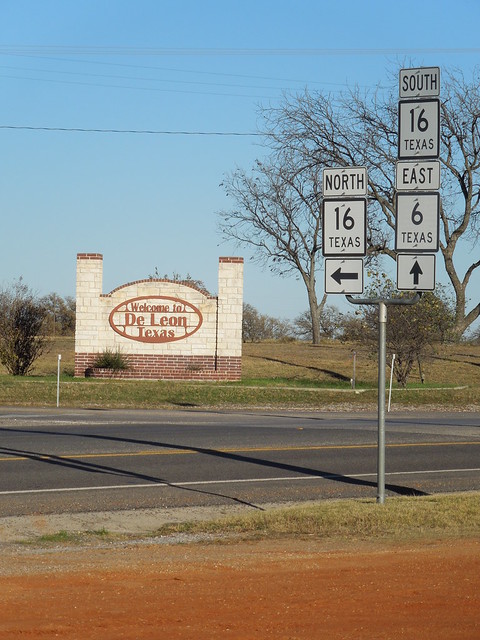
Feb. 01, 2017: originally posted to my old blog
Apr. 28, 2024: last updated
These two routes first intersected in 1945, when TX 6 was extended. Another result of that extension was that TX 6 became the longest state highway in Texas for the next 20 years, until TX 16 assumed that honor in 1965. The history of the changes that led to the current arrangement is largely a story of renumberings due to conflicts with US route numbers in Texas.
On the 1935 official state highway map (the earliest I have seen), TX 6 began in the Galveston area (as it still does) and ran northwest, but it ended in Waco. At the time, the road running northwest out of Waco through De Leon was TX 67.
Meanwhile, TX 16 was quite different than today's routing. It began in Falfurrias, running up to San Antonio via an indirect route through Corpus. The route of today's TX 16 northwest from San Antonio to De Leon was designated TX 81.
So in 1935, the highway junction in De Leon involved TX 67 and TX 81. The 1939 map was the last that still showed that arrangement:

The US 81 designation was established in Texas in 1927, and US 67 was extended southwest of Dallas by 1930. Both of those routes intersected the state highway of the same number (US 81/TX 81 in San Antonio, and US 67/TX 67 in Dublin, just down the road from De Leon).
The 1937 map was the first to show the US 81/TX 81 junction had been eliminated: TX 16 was extended north, replacing TX 81 from San Antonio to Fredericksburg. Three years later, the TX 16 designation had been extended along the remainder of what had been TX 81, ending in De Leon:

Incidentally, note that TX 67 did not use Navarro Street on the west side of town. Rather, traffic came in on Bivar Street, junctioning TX 16 at Fannin Street before stair-stepping up to Navarro.
It should also be noted that TXDoT's 1939 description of TX 16 had it ending north of De Leon, at the Possum Kingdom dam. However, the road between De Leon and Strawn was not constructed until the 1950s. So if TX 16 was actually signposted north of De Leon, then it must have used a temporary routing along TX 67 through Eastland.
In 1945, the US 67/TX 67 junction in Dublin was eliminated: the TX 6 designation was extended northwest from Waco, replacing TX 67 all the way to Breckenridge, and then continuing almost to Throckmorton. This increased the total length of TX 6 to over 420 miles, causing it to surpass TX 36 (at 392 miles) as the longest state highway.
That also became the first time that TX 6 and TX 16 shared a junction, but at the time TX 16 was the third-longest state highway. It became the longest 20 years later: in 1965, TX 16 was extended south from San Antonio to its current terminus in Zapata, increasing its length to over 500 miles. By then the Rio Grande had been impounded behind Falcon Dam for about a decade, so the original townsite of Zapata had been inundated by the International Falcon Reservoir, and the town of Zapata had already been relocated to its current site on the rerouted US 83.
After another four years TX 16 was extended north to its existing terminus near Windthorst, thus attaining its current length. The photo below was taken looking south on US 281; the north beginning of TX 16 is to the right:

Below, we are looking the opposite direction (north on US 281). Despite what the sign indicates, US 281 does not continue to the left. It continues straight ahead (as indicated by the confirming assembly in the distance). However, TX 16 does indeed begin to the left:

In 1975, TX 6 was extended north to its current terminus at the Oklahoma line (along what had been TX 283, which was eliminated because of... yep, you guessed it: a conflict with the nearby US route of the same number). That same year, Oklahoma extended its state highway 6 southward to meet TX 6 at the bridge over the Red River (which forms the boundary between the two states). Clearly these changes were not coincidental; the two states coordinated their efforts to establish a unified highway designation that spanned the state line. The photo below shows the last northbound TX 6 marker...

...but upon crossing the Red River into Oklahoma, travelers find that they are still on route 6:

Looking the opposite direction, the photo below shows the first southbound TX 6 marker as one enters the state from Oklahoma:

OK 6 is 113* miles in length, so if one wanted to think about TX 6 and OK 6 as a combined "multi-state route 6", its total length would be 664 miles. On the map below, OK 6 is shown in red, TX 6 is purple, and TX 16 is blue:
It should be noted that TXDoT did not always eliminate intersections of the same number, and in at least one instance it created a new conflict. In 1947, TX 18 was eliminated in favor of TX 70, which was extended north through Matador, where it intersected US 70 (an arrangement that still exists today):

*At the time of writing, these mileages did not match the figures listed on the corresponding Wikipedia pages. I did the measurements manually, and I believe WP is in error. With the Texas mileages, I suspect the reason is because the TXDoT source cited by WP editors does not take all concurrencies into account.


On the 1935 official state highway map (the earliest I have seen), TX 6 began in the Galveston area (as it still does) and ran northwest, but it ended in Waco. At the time, the road running northwest out of Waco through De Leon was TX 67.
Meanwhile, TX 16 was quite different than today's routing. It began in Falfurrias, running up to San Antonio via an indirect route through Corpus. The route of today's TX 16 northwest from San Antonio to De Leon was designated TX 81.
So in 1935, the highway junction in De Leon involved TX 67 and TX 81. The 1939 map was the last that still showed that arrangement:

c. 1939, TXDoT
The 1937 map was the first to show the US 81/TX 81 junction had been eliminated: TX 16 was extended north, replacing TX 81 from San Antonio to Fredericksburg. Three years later, the TX 16 designation had been extended along the remainder of what had been TX 81, ending in De Leon:

c. 1940, TXDoT
It should also be noted that TXDoT's 1939 description of TX 16 had it ending north of De Leon, at the Possum Kingdom dam. However, the road between De Leon and Strawn was not constructed until the 1950s. So if TX 16 was actually signposted north of De Leon, then it must have used a temporary routing along TX 67 through Eastland.
In 1945, the US 67/TX 67 junction in Dublin was eliminated: the TX 6 designation was extended northwest from Waco, replacing TX 67 all the way to Breckenridge, and then continuing almost to Throckmorton. This increased the total length of TX 6 to over 420 miles, causing it to surpass TX 36 (at 392 miles) as the longest state highway.
That also became the first time that TX 6 and TX 16 shared a junction, but at the time TX 16 was the third-longest state highway. It became the longest 20 years later: in 1965, TX 16 was extended south from San Antonio to its current terminus in Zapata, increasing its length to over 500 miles. By then the Rio Grande had been impounded behind Falcon Dam for about a decade, so the original townsite of Zapata had been inundated by the International Falcon Reservoir, and the town of Zapata had already been relocated to its current site on the rerouted US 83.
After another four years TX 16 was extended north to its existing terminus near Windthorst, thus attaining its current length. The photo below was taken looking south on US 281; the north beginning of TX 16 is to the right:

Sanderson, Mar. 2023
*At the time of writing, these mileages did not match the figures listed on the corresponding Wikipedia pages. I did the measurements manually, and I believe WP is in error. With the Texas mileages, I suspect the reason is because the TXDoT source cited by WP editors does not take all concurrencies into account.


Comments
Post a Comment